[Note: this post was prompted by a Quora question. My answer is provided in this blog post. Others are given on Quora at the hyperlink.]
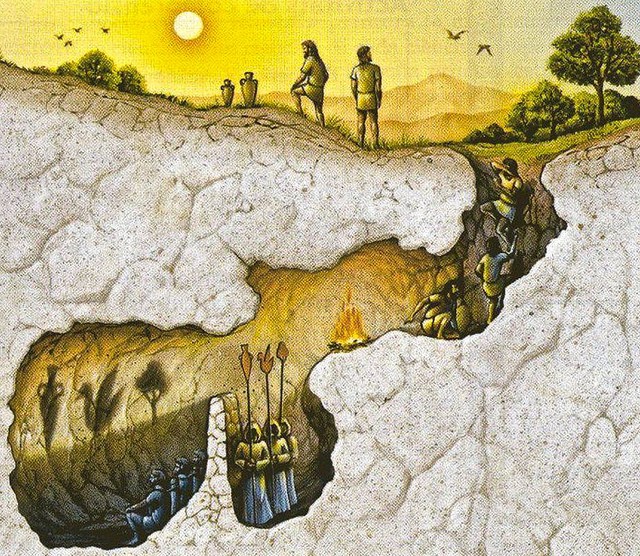
Atheists: Where do you stand in Plato's cave, and what are the other three groups of people from your perspective? As you can see in this picture, there are four kinds of people:
those watching shadows
those who understand shadows
those who are on the way out of the cave
those that are out of the cave
My Answer
I’m puzzled that the question is directed to atheists. The heart of the allegory of the cave concerns fundamental epistemological and cognitive issues. Its theological and spiritual aspects are interesting but secondary, I think, to those core concerns. Theistic, agnostic, and atheistic views are likely to vary, but they are all capable of presenting a viable answer. To me, the question is better addressed to philosophers in general, or to no particular group at all, since all those answers are likely to invoke (or reject) theological and spiritual aspects of our cognitive abilities and capacities.
As an example, atheists' answers in particular must rely on scientism alone as it is rooted in Enlightenment naturalism and rationalism. As for where they would sit or stand in the cave or outside it, or on the way to or from one or the other, I expect they would be among all those groups - none of the four groups specified necessarily rules out atheism (or any other theology or religion).
Regarding the four groups:
Did everyone out of the cave come from the cave, or are there fifth and sixth groups who either know nothing of the cave or know of it but have never entered it?
Where do the people come from in the first place? Are they born into the bottom level or placed there as newborns? Is this a subtle view of a class-ordered or caste society?
Where did the cave come from? Is it a natural formation or was it constructed in this form? Either way, who put it to this use and who oversees its ongoing operations and activities?
Is there any conclusive evidence that "out of the cave" isn't just a vastly more complex and cognitively convincing "cave?"
It may help to consider contemporary allegories dealing with the same concerns - cognition and epistemology. Two I expect many of us will easily recognize are The Truman Show and The Matrix franchise. These movies are equivalent to Plato’s allegory, transformed by Hollywood craft and effects, but keeping the arc and theme of the story intact. Here is the essence of what both the ancient allegory and those contemporary movies are about.
cognitive dissonance - basically, Cognitive dissonance as explained in that Wikipedia article as “the (internal) mental stress or discomfort experienced by an individual who holds two or more contradictory beliefs, ideas, or values at the same time, performs actions contrary to one or more of those beliefs, ideas, or values, or is confronted by new information that conflicts with existing beliefs, ideas, or values.” I prefer the concept of
semiotic dissonance, however, which subsumes the conventional definition of cognitive dissonance but expands and extends beyond it to include states of complete and total cognitive deception and delusion constituting a false reality or ‘irreality’ that may be self-imposed or even independently conceived, engineered, constructed, and implemented by external parties, powers, and forces for explicit intents and purposes of mass totalitarian oppression, enslavement, tyranny, and control. This irreality establishes
epistemic imprisonment - through which all sentient and sapient aspects of cognition are constrained and distorted (if self-imposed), or (if externally devised) manipulated and controlled for the creation, maintenance, and exploitation of the irreality thus created and the captives within it as means to achieve the ends of the ruling power elite.
It is especially important to realize that the most effective irreality of semiotic dissonance and epistemic captivity is not necessarily unpleasant, painful, or even stressful. In this most insidiously seductive form and maliciously nefarious mode most if not all of its captives have no awareness or recognition of their enslavement. On the contrary, most will adamantly reject the idea that they are in any way deceived or delusional, often and forcefully insisting their lives are true and real as believed—even quite meaningful, fulfilling, and rewarding.
Hence the crucial question: which of the following is the true reality, and which is the dissonant irreality?
We the people of earth freely exercise our inalienable rights, including those of life, liberty, and pursuit of happiness. The US is a constitutional republic and representative democracy. As the most powerful country on earth, the US has moral obligation and authority to empower other people and nations to recognize and exercise those same rights and to adopt the same governance. Furthermore, the US has manifest destiny and just cause for the judicious use of military power and force to defend those rights and to establish and uphold that governance against all enemies foreign or domestic.
The vast majority of humans are victims of semiotic dissonance and epistemic imprisonment orchestrated and exploited by an elite plutocratic oligarchy and their corporatocracy. They exercise global power with virtually absolute control, lacking any and all humane, moral, or conscionable integrity or bearing, driven solely by greed, hubris, and depravity. This irreality is imperceptible to its captive victims, but the oppression and tyranny hiding in plain sight within it is nonetheless totalitarian to the core.
Are these two scenarios jointly exhaustive and mutually exclusive as factual and true descriptions of life on earth today? Or is it a false dilemma wherein a path between its horns may lead to a different, truer, actual reality? If semiotic dissonance and epistemic imprisonment are the actual but imperceptible facts of human life today, is escape even possible? Can the real world ‘cave’ of epistemic enslavement be destroyed, The Truman Show cancelled, the red pill acquired and swallowed so The Matrix will be overthrown?
Exercise for the reader: can you name other highly similar or equivalent allegories (e.g., in film, print, or other media)? Would Stanley Kubrick's A Clockwork Orange, The Shining, or Eyes Wide Shut qualify? How would you interpret current events (such as the upcoming 2016 presidential election) from the perspective of the two alternate realities described above? Do Noam Chomsky's books, documentary, and interview, Requiem for the American Dream (book), Who Rules the World? (video) prove #2 above is correct?
P. S. As a dissident Christian, of course, the spiritual and theological issues are anything but "secondary." They are both primary and transcendent. But the aim of this post is to present a more inquisitive and religiously unbiased perspective. Obviously my sociopolitical biases are showing, but I think that's precisely what Socrates would have wanted, especially since the cave allegory appears within the political philosophy context of The Republic.